
Wife Discovers Why 20 Years of "Trying Everything" Never Stopped Her Husband's Snoring (And What Finally Did)
Reading time: 2 min

My marriage was dying, and I couldn't stop it.
If your partner snores like a freight train...
If you've spent hundreds at Boots on strips, sprays, and gadgets that promised results...
If you've ever lain awake at 3am wondering if separate bedrooms are just the beginning of the end...
Then what I'm about to share could save your relationship.
There's something 80% of couples dealing with snoring don't know.
And here's the scary part: The solutions you've been trying might be completely useless—not because they're bad products, but because they're designed for a different problem entirely.
I'm talking about something sleep specialists call "the wrong type of snoring."
It's why the strips didn't work.
It's why the sprays wore off.
It's why you've "tried everything" and nothing's changed.

The Night I Nearly Lost Everything
Two years ago, after 18 years of marriage to my husband David, I found myself crying on our sofa at 4am.
Not because of a row. Not because of money troubles.
Because I couldn't remember the last time I'd slept through the night.
David's snoring had always been there. But somewhere around his 50th birthday, it became horrific.
"Think being inches away from a 747 as it takes off," I told my sister. "Every. Single. Night."
I'd tried everything from Boots—nasal strips, throat sprays, those chin strap things. I'd bought three different "anti-snore pillows."
Nothing made a blind bit of difference.
Most nights, I'd end up in the spare room. David hated it. Said it made him feel like we were "living as roommates, not husband and wife."
He wasn't wrong.
I'd started to wonder if this was just... it. If separate bedrooms at 52 meant separate lives by 60.
Then one morning, after yet another sleepless night, I typed something into Google that changed everything:
"Why don't nasal strips work for snoring?"

The Discovery That Made Me Feel Like a Fool (In the Best Way)
What I found shocked me.
According to sleep research, there are two completely different types of snoring—and most people have no idea which one they're dealing with.
Type 1: Nasal snoring. This happens when your nasal passages are blocked or narrow. Nasal strips, sprays, and decongestants can help because they open up the nose.
Type 2: Throat snoring. This is what 80% of chronic snorers actually have. It happens when the jaw relaxes during sleep, falls backward, and drags the tongue into the airway.
Here's the thing that made me want to scream:
Every single product I'd bought was designed for Type 1.
The strips? They open your nostrils. Great if your problem is nasal congestion. Completely useless if your tongue is blocking your throat.
The sprays? They lubricate the throat temporarily. But they don't stop the jaw from falling backward.
The pillows? They might help with positioning, but they can't physically hold the jaw in place all night.
I hadn't failed. The products hadn't failed.
I'd been treating a throat problem with nose solutions.
It was like using ear drops for a sore throat and wondering why it wasn't working.

How I Finally Figured Out What David Actually Needed
Once I understood the difference, I did a simple test that anyone can do:
I watched David fall asleep.
Within minutes of drifting off, his mouth fell open. His jaw dropped backward. And then—that horrible sound.
When I gently held his jaw forward (just for a second), the snoring stopped immediately.
That's when I knew: David didn't have a nose problem. He had a jaw position problem.
What he needed wasn't strips or sprays. He needed something that would hold his jaw slightly forward during sleep—keeping his tongue from collapsing into his airway.
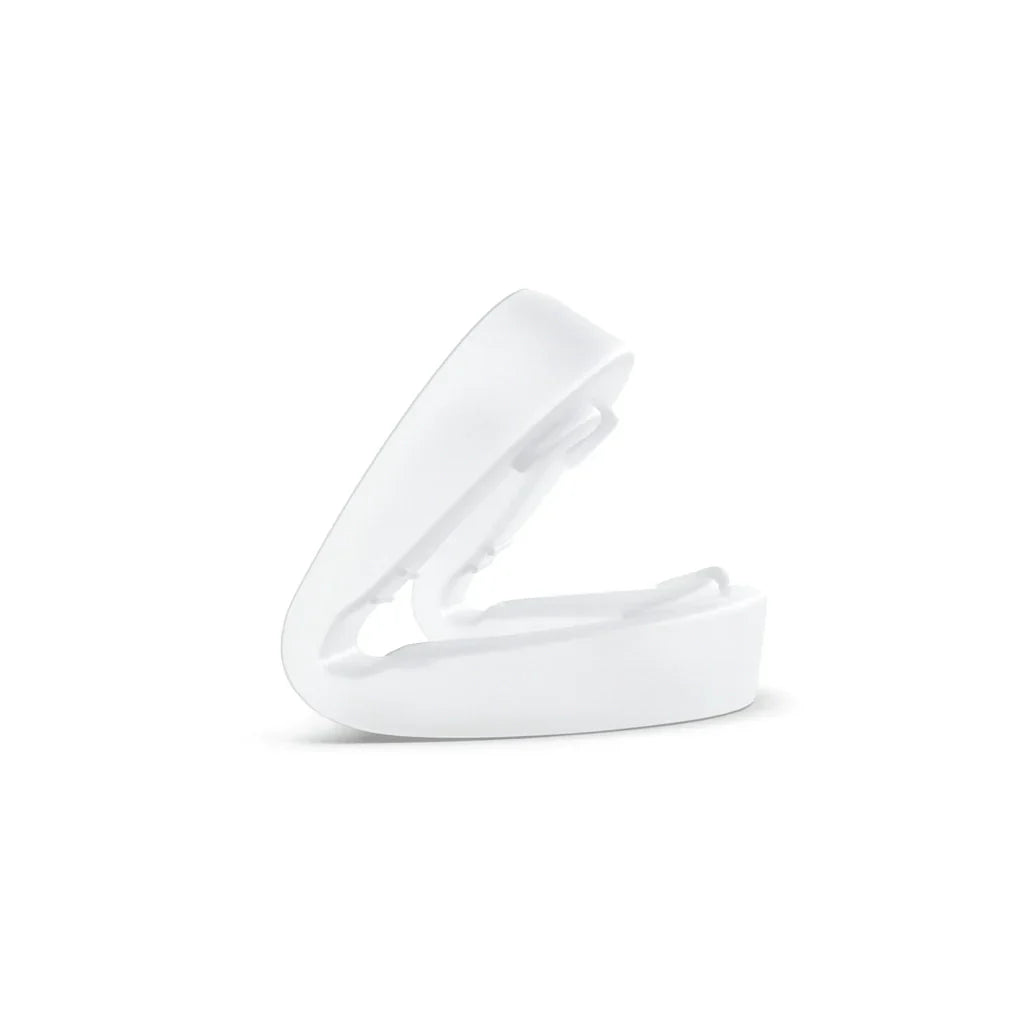
That's when I discovered mandibular advancement mouthpieces.

What Actually Works for Throat Snoring
These mouthpieces work on a simple principle: they hold your lower jaw forward by just 3-5mm while you sleep.
That small adjustment keeps the tongue from falling backward and blocking the airway.
It's the same mechanism NHS sleep clinics use—just without the 12-month wait or the £600 dentist bill.
I found a UK company called AirRest that makes a mouldable version you can fit at home. Same principle as the dentist-fitted devices, fraction of the cost.
The first night David wore it, I braced myself for the usual symphony.
It never came.
I actually woke up at 5am in a panic, convinced something was wrong because the house was so quiet.
David was sleeping peacefully. Mouth closed. No snoring.
I lay there and cried—but for the first time in years, they were happy tears.

Six Months Later: We Sleep Together Again
That was six months ago.
We've been back in the same bed ever since. No more spare room. No more 3am sofa sessions.
David says he finally understands why I was so exhausted all those years. "I didn't realise how bad it was because I was asleep through it," he told me. "I'm so sorry."
But here's what matters: it wasn't his fault. And it wasn't mine for "nagging."
We just didn't know there were two types of snoring—and we'd been treating the wrong one for 20 years.
Is This Why Nothing's Worked for You?
If you've "tried everything" and your partner still snores, ask yourself:
Does their mouth fall open when they snore? If yes—it's throat snoring.
Did nasal strips make zero difference? That confirms it's not a nose problem.
Can you briefly stop the snoring by gently pushing their jaw forward? That's your proof.
If you answered yes to any of these, you've been treating the wrong type of snoring.
Click here to check availability of the AirRest mouthpiece and see if it's right for your situation.

Don't Wait Another 20 Years Like I Did
"We've booked our first holiday in the same room in 10 years." — Emma, Manchester
What Others Are Saying:
"After 8 years of marriage we are finally able to share a bed again without one of us ending up on the couch!" — Sarah, Leeds
"My delighted wife reported my snoring completely stopped. This little piece of plastic fixed my 15-year battle with snoring." — James, Bristol
"I used to wake up just as tired as when I went to sleep. Now I wake up refreshed for the first time in over a decade." — Mark, Birmingham
90-Day Money-Back Guarantee | UK-Based Company | NHS-Recommended Mechanism


AirRest™ 2025 | Anti-Snoring and Anti-Sleep Apnea Mouthpiece | On Offer
AirRest™ 2025 | Anti-Snoring and Anti-Sleep Apnea Mouthpiece | On Offer
😴 Say goodbye to the spare room: finally sleep together again.
💑 Save your relationship: no more resentment, just peaceful nights.
✨ Comfort from night one: moulds to your teeth in minutes.
Couldn't load pickup availability



Dr. Sarah Mitchell — NHS Sleep Consultant & Respiratory Physician (Manchester)
In 22 years of practice, I've seen snoring destroy more relationships than most people would believe. Couples come to me at breaking point—sleeping apart, resentful, some on the verge of divorce.
After recommending AirRest™ to patients who couldn't tolerate CPAP or faced our 18-month NHS waiting lists, the feedback has been remarkable. For throat-based snoring without underlying sleep apnoea, this device delivers what nasal strips and sprays simply cannot—it addresses the actual mechanical cause.
By holding the jaw forward just millimetres, it keeps the airway open and stops the tongue collapsing backward. The same principle we use in £600 dental devices, now accessible at home.
What strikes me most isn't the clinical improvement—it's the emotional transformation. Patients tell me: 'We're back in the same bed for the first time in years.' Partners who were exhausted, angry, considering separation—now sleeping through the night together.
Snoring isn't just a noise problem. It's a relationship problem. And for couples who've tried everything else, AirRest offers a solution that actually targets the root cause. I've seen it bring couples back from the brink.
FAQs
We've tried nasal strips, sprays, pillows, chin straps—nothing worked. Why would this be any different?
We've tried nasal strips, sprays, pillows, chin straps—nothing worked. Why would this be any different?
Here's the thing: those products aren't broken. They're designed for nasal snoring—when the problem is blocked nostrils. But 80% of chronic snorers have throat snoring, where the jaw falls back and drags the tongue into the airway. Nasal strips can't fix that. It's like using ear drops for a sore throat. The AirRest works on a completely different principle—it holds the jaw forward by just 3-5mm, keeping the tongue out of the airway. That's why it works when everything else failed. You weren't failing. You were just treating the wrong type of snoring.
My husband says he "can't help it" and refuses to try anything else. How do I convince him?
My husband says he "can't help it" and refuses to try anything else. How do I convince him?
We hear this constantly. After years of failed solutions, many snorers give up and assume nothing will work. Here's what other wives have done: Show him this simple test. Tonight, when he starts snoring, gently push his jaw forward for a few seconds. If the snoring stops immediately—that's proof he has throat snoring, and proof that jaw positioning works. That 10-second test often convinces even the most stubborn husbands. And remind him: the AirRest has a 90-day money-back guarantee. If it doesn't work, you get your money back. There's literally nothing to lose—except the spare room.
Is it comfortable? I'm worried he'll rip it out in his sleep.
Is it comfortable? I'm worried he'll rip it out in his sleep.
Most people need 3-5 nights to fully adjust. The first couple of nights might feel strange—your jaw isn't used to being held in position. Some people experience mild jaw ache, similar to wearing a retainer for the first time. But here's what we hear over and over: "By night five, I didn't even notice it." The AirRest moulds to YOUR teeth specifically, so it's not a generic one-size-fits-all piece of plastic. That custom fit makes all the difference. Most partners report their snorer keeps it in all night from the first week onwards.
My dentist quoted me £600 for a mouthpiece. How can AirRest work at a fraction of the price?
My dentist quoted me £600 for a mouthpiece. How can AirRest work at a fraction of the price?
Dentist-fitted devices and the AirRest use the exact same mechanism—holding the jaw forward to keep the airway open. What you're paying the dentist for is the fitting process, the appointments, and their time. The AirRest uses a boil-and-bite moulding system that lets you create a custom fit at home in minutes. Same principle. Same jaw advancement. Just without the £600 markup. That's why NHS sleep clinics recommend this type of device—and why so many people are skipping the 12-month NHS wait and getting results now.
We've been sleeping in separate rooms for years. Is it too late for this to help us?
We've been sleeping in separate rooms for years. Is it too late for this to help us?
Absolutely not. We've heard from couples who slept apart for 5, 10, even 15 years—and are now back in the same bed. The damage from years of separate bedrooms isn't physical. It's emotional distance, lost intimacy, feeling like roommates. That can heal surprisingly fast once you're sleeping together again. One customer told us: "We've booked our first holiday in the same room in 10 years." It's never too late. The real question is: how much longer do you want to wait?
His snoring is REALLY loud—like a freight train. Will this work for severe snoring?
His snoring is REALLY loud—like a freight train. Will this work for severe snoring?
The louder the snoring, the more likely it's throat-based—which is exactly what the AirRest addresses. The volume comes from air forcing past the collapsed tissue in the throat. By holding the jaw forward and keeping the airway open, you're eliminating the obstruction that causes that chainsaw sound. We've had customers whose partners described the snoring as "shaking the walls" and "waking the neighbours"—and they're now sleeping in silence. Severity isn't a barrier. If anything, severe snorers often see the most dramatic results.
What if he has sleep apnoea? Should he see a doctor instead?
What if he has sleep apnoea? Should he see a doctor instead?
If you suspect sleep apnoea—especially if he stops breathing during the night, gasps awake, or is exhausted despite "sleeping" 8 hours—yes, he should see a GP for a proper diagnosis. However, here's the reality: NHS waiting lists for sleep studies are currently 12-24 months in many areas. Many people use the AirRest while waiting for their NHS appointment. In fact, mandibular advancement devices are one of the NHS-recommended treatments for mild to moderate sleep apnoea. The AirRest isn't a replacement for medical advice, but it can provide relief while you're stuck in the queue.
How long does the AirRest last before I need to replace it?
How long does the AirRest last before I need to replace it?
With proper care—rinsing after use and storing it dry—the AirRest typically lasts 6-12 months. Some customers report theirs lasting over a year. You'll know it's time to replace when the mould starts to feel loose or the material shows wear. Compare that to spending £600 every few years at the dentist, or £15-20 monthly on sprays and strips that don't even work. Over time, the AirRest is by far the most cost-effective solution—and the only one that actually addresses throat snoring.
What if it doesn't work for us? I can't afford to waste more money.
What if it doesn't work for us? I can't afford to waste more money.
We completely understand. After years of buying products that promised results and delivered nothing, skepticism is natural. That's exactly why the AirRest comes with a 90-day money-back guarantee. Not 14 days. Not 30 days. 90 days—enough time to properly adjust and see real results. If it doesn't work for you, send it back for a full refund. No questions, no hassle. We can offer this because the vast majority of customers see results within the first week. But we want you to feel completely protected.
I'm worried this is just another gimmick. Is there actual science behind it?
I'm worried this is just another gimmick. Is there actual science behind it?
Mandibular advancement isn't new or experimental—it's been used by dentists and sleep clinics for decades. The science is straightforward: when you sleep, your jaw relaxes and falls backward. This pulls your tongue into your airway, causing the vibration we call snoring. By holding the jaw forward just 3-5mm, you prevent the tongue from collapsing backward. NHS sleep clinics recommend mandibular advancement devices. The British Snoring & Sleep Apnoea Association has tested this type of device. This isn't a gimmick—it's the same proven mechanism used in £600 dentist-fitted devices, just made accessible for home use.
What our customers say
+1353 Reviews


